Sizing a solar system for an off-grid cabin is a math problem — but it’s not a hard one. Most people get it wrong because they either guess (ending up with a system too small to run their fridge) or over-engineer it (spending $8,000 on panels when $3,000 would do). This guide gives you the exact process, step by step, with real numbers.
Step 1: Calculate Your Daily Energy Use (Watt-Hours)
Before you buy a single panel, you need to know how much power you actually use each day. Go through every device in your cabin and estimate daily runtime:
| Appliance | Watts | Hours/Day | Watt-Hours/Day |
|---|---|---|---|
| LED lights (6 bulbs) | 60W | 4 hrs | 240 Wh |
| Refrigerator (efficient 12V) | 45W | 24 hrs* | 500 Wh |
| Laptop | 65W | 4 hrs | 260 Wh |
| Phone chargers (×2) | 20W | 2 hrs | 40 Wh |
| Water pump | 150W | 0.5 hrs | 75 Wh |
| Total | 1,115 Wh/day |
*Refrigerators cycle on/off, so a 45W unit running 24 hrs typically uses around 500 Wh.
Add 20–25% for inverter losses and wire inefficiency. So 1,115 × 1.25 = ~1,400 Wh/day is your real target.
Step 2: Factor In Your Solar Hours (Peak Sun Hours)
“Peak sun hours” (PSH) is the average number of hours per day your location receives full-strength solar irradiance. This varies massively by location and season:
- Arizona, New Mexico: 5.5–6.5 PSH
- Pacific Northwest, Great Lakes: 3.5–4.5 PSH
- Southeast, Mid-Atlantic: 4.5–5.5 PSH
Design for your worst month, typically December or January. If you’re in Tennessee and get 4 PSH in winter, use 4.
Step 3: Calculate Panel Wattage Required
Formula: Daily Wh ÷ Peak Sun Hours = Required Panel Watts
Using our example: 1,400 Wh ÷ 4 PSH = 350 watts of solar
Add another 25% for real-world panel losses (dirt, temperature, angle): 350W × 1.25 = ~440W
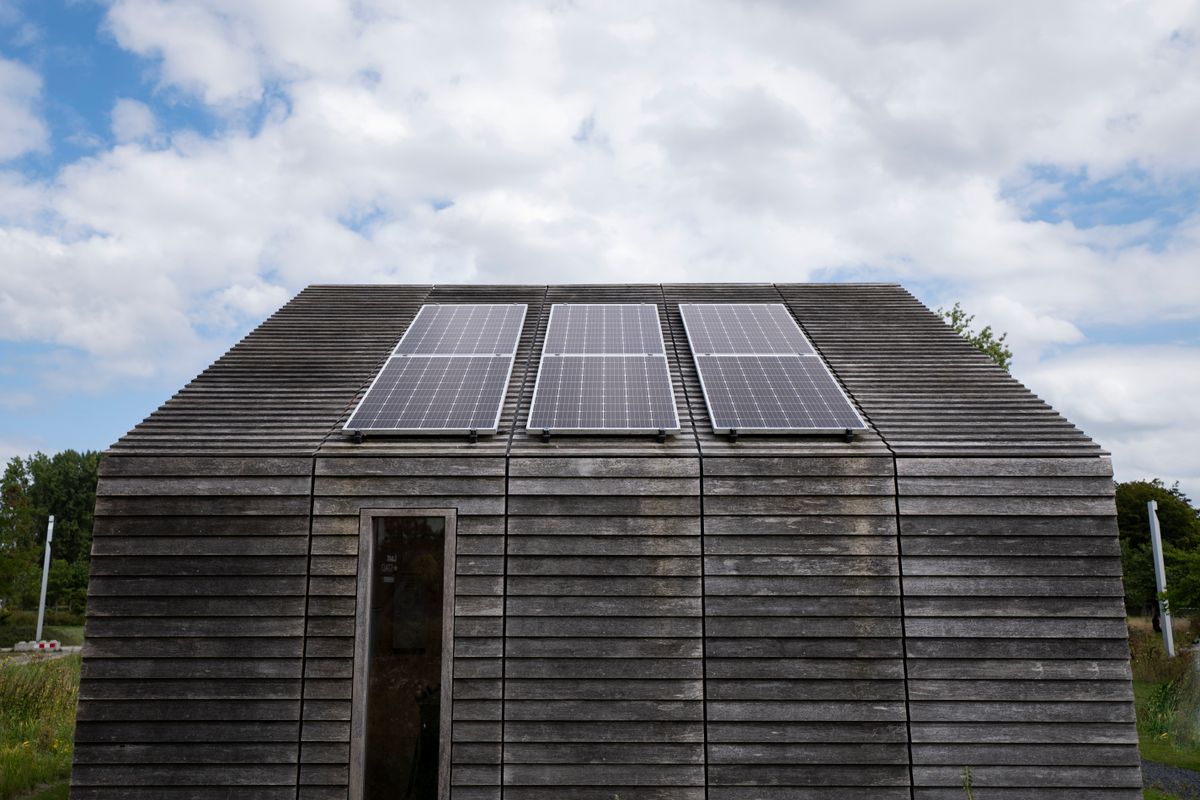
You’d round up to 400–500W of panels — two 200W panels or four 100W panels wired in series-parallel.
Step 4: Size Your Battery Bank
Your battery bank needs to store enough energy to run your cabin through cloudy days. The standard rule is 2–3 days of autonomy.
Formula: Daily Wh × Days of Autonomy ÷ Usable Depth of Discharge
- For AGM batteries (50% DoD): 1,400 Wh × 2 days ÷ 0.50 = 5,600 Wh of battery capacity
- For LiFePO4 batteries (80% DoD): 1,400 Wh × 2 days ÷ 0.80 = 3,500 Wh of battery capacity
In amp-hours at 12V: 3,500 Wh ÷ 12V = 292 Ah — so two 150Ah LiFePO4 batteries in parallel.
ð Our Pick: LiTime 100Ah LiFePO4 Battery — ~$219/battery, 4,000+ cycle life, built-in BMS
For a 300Ah bank you’d need 3 of these in parallel. Excellent value for the capacity.
As an Amazon Associate we earn from qualifying purchases.

Step 5: Choose Your Charge Controller
Your charge controller manages the flow of energy from panels to batteries. The two types are PWM and MPPT — always use MPPT for off-grid systems over 200W. MPPT controllers extract 20–30% more energy from the same panels.
How to size it:
- Add up total panel wattage: 440W
- Divide by battery voltage: 440W ÷ 12V = 36.7A
- Add 25% safety margin: 36.7A × 1.25 = ~46A controller
Round up to a 50A or 60A MPPT controller.
Step 6: Size Your Inverter
If you’re running AC appliances (standard outlets), you need an inverter. Size it based on your highest simultaneous load — not your total daily usage.
If you might run a microwave (1,000W) and your laptop (65W) and a few lights (60W) at the same time: 1,000 + 65 + 60 = 1,125W continuous. A 2,000W pure sine wave inverter gives you headroom.
Common Sizing Mistakes
Undersizing battery banks is the #1 error. People calculate panels correctly but forget that 3 cloudy days in a row will drain an undersized bank. Build in at least 2 days of autonomy.
Using panel wattage at STC. Panels are rated under perfect lab conditions. Real-world output is 75–80% of that. Always derate by 20–25%.
Ignoring temperature. LiFePO4 batteries charge poorly below 32°F (0°C) and should not be charged at all below 14°F (-10°C). If you’re in a cold climate, either keep your batteries inside or buy a battery with a self-heating BMS.
Not planning for expansion. Buy a charge controller rated for more amps than you currently need. Adding panels later is common, and replacing the controller is an avoidable cost.
Quick Reference: System Size Tiers
| System | Daily Use | Panels | Battery | Use Case |
|---|---|---|---|---|
| Micro | 200–400 Wh | 100–200W | 100Ah LiFePO4 | Lights, phone, small fan |
| Basic | 400–800 Wh | 200–400W | 200Ah LiFePO4 | + laptop, water pump |
| Comfortable | 800–1,500 Wh | 400–600W | 300–400Ah LiFePO4 | + refrigerator, TV |
| Full Off-Grid | 1,500–3,000 Wh | 800W–2kW | 600Ah+ LiFePO4 | Full household loads |
Use Our Free Solar Sizing Calculator
Punch in your appliances and location at our off-grid solar sizing calculator and get a parts list in minutes.
FAQ
How many solar panels do I need for a small off-grid cabin? For a cabin using 1,000–1,500 Wh/day (lights, laptop, small fridge), you typically need 400–600W of solar panels — two to three 200W panels — paired with a 300–400Ah LiFePO4 battery bank.
Can I run a refrigerator on a 200W solar system? Barely, and only in summer in a sunny location. An efficient 12V compressor fridge uses ~500 Wh/day. A 200W system in a good location produces roughly 800 Wh/day, leaving little margin for other loads or cloudy days. 400W is the minimum comfortable size for a fridge plus other loads.
What’s the difference between PWM and MPPT charge controllers? MPPT controllers convert excess panel voltage into usable charging current, recovering 20–30% more energy. For systems over 200W, the extra cost of MPPT pays back quickly. PWM is fine for very small systems under 100W.
How do I know my peak sun hours? The Global Solar Atlas is the best free tool. Enter your location and it shows monthly average peak sun hours. Always design for your lowest winter month.
Is 12V or 24V better for off-grid cabins? For systems under 2,000W, 12V works well and gives you more compatible components. For larger systems (2,000W+), 24V or 48V reduces wire losses and is usually better. Most serious off-grid homesteads run 24V or 48V.